Property & built world
Architecture & interior design
HNI clients buy taste and trust before they buy a quote.
The short answer
An architecture or interior design website sells taste first and process second. Homeowners want to see finished spaces in full, understand how you work and roughly what it costs, and reach someone without a long form. The best studio sites qualify the brief up front, so the team spends its time on the right projects instead of on discovery calls that go nowhere.
Must-haves, and why
Full-bleed project stories with the brief, the plan and the finished space thumbnails don't sell space.
Honest budget bands or a “projects start from” line it filters out mismatched leads before the first call.
A short qualifying quiz: property type, size, scope, city, timeline every lead arrives with context.
Consult and WhatsApp buttons in every section high-intent visitors don't scroll back to the top.
Your process in clear stages: concept, design, approvals, execution, handover clients fear the unknown more than the fee.
Turnkey vs design-only stated clearly it is the most common source of confusion in this industry.
Before-and-after photos of real rooms proof that the drawings became a home.
Council of Architecture registration for architects only registered architects may use the title in India.
Campaign source saved with every enquiry so you know which ads bring real projects, not just clicks.
Fast image delivery large galleries are where design sites lose mobile speed.
Authority & trust signals
Pages to build
Common mistakes
- An Instagram grid copied onto the website with no brief, no location and no story.
- No price signal at all, so every single enquiry needs a call just to qualify it.
- Long contact forms that ask for everything before any trust is built.
- Galleries of uncompressed 4–5 MB images that crawl on a phone.
- Only renders and no completed, photographed spaces.
Our take · Aliasgar Barodawala
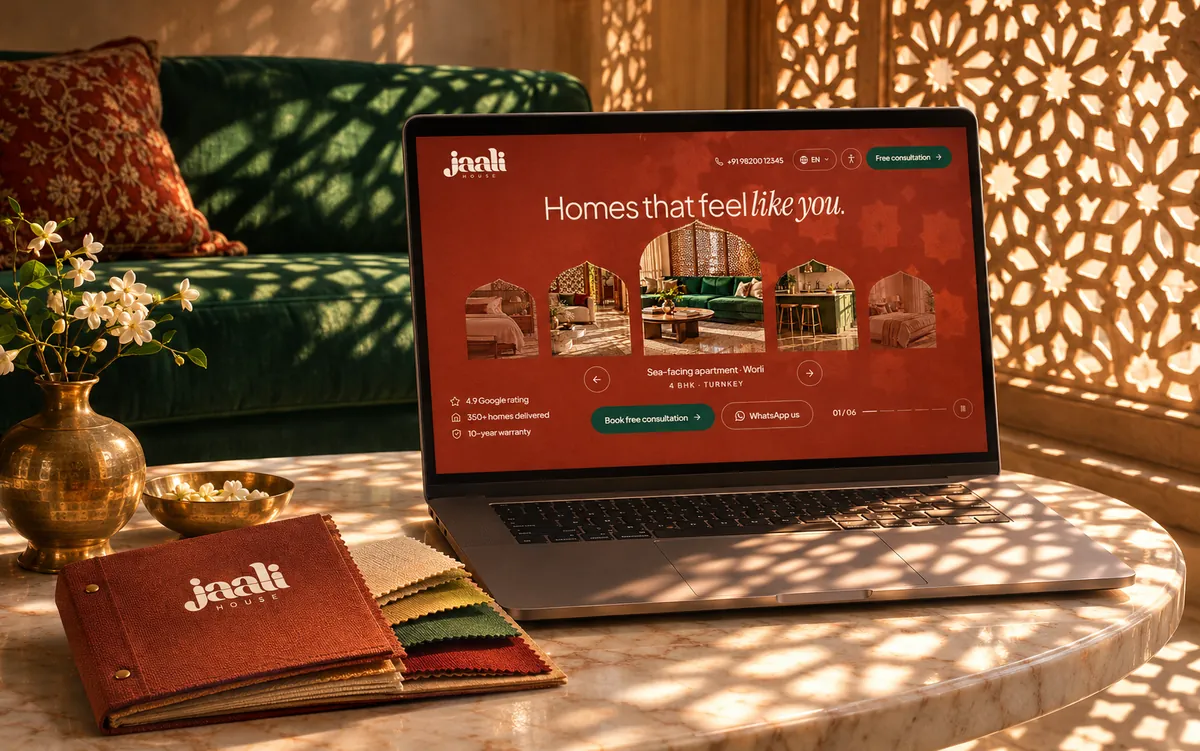
On Jaali House, a premium interior studio running Instagram ads for homeowners in Tier 1 cities, the goal was fewer, better leads. I built a three-step “What are you looking for?” quiz that ends in a result card, put a Consult or WhatsApp button in every section, and added sticky bars on desktop and mobile with a one-time pop-up after four seconds.
Quiz answers and ad-campaign tags land straight in the dashboard, so every enquiry arrives already qualified, with its source attached, in four languages: English, Hindi, Marathi and Gujarati. One honest number: mobile performance was 72 at delivery, so I optimised it afterwards. A WebGL background like the red jaali light costs speed, and on a lead-generation page it has to earn its place.
Brands named here are my own self-initiated concepts unless marked Client work. Paid client work is under NDA.
Lead quality matters more than lead count here. Two good questions up front save hours of calls.
From the work · Jaali House
- The brief
A premium interior studio needed fewer, better leads from paid campaigns.
- What we did
A three-step “What are you looking for?” quiz, consult and WhatsApp in every section, and campaign tags passed straight into the dashboard.
- What it does
Every enquiry arrives already qualified, with its source attached. Mobile performance was then raised from 72 after delivery.
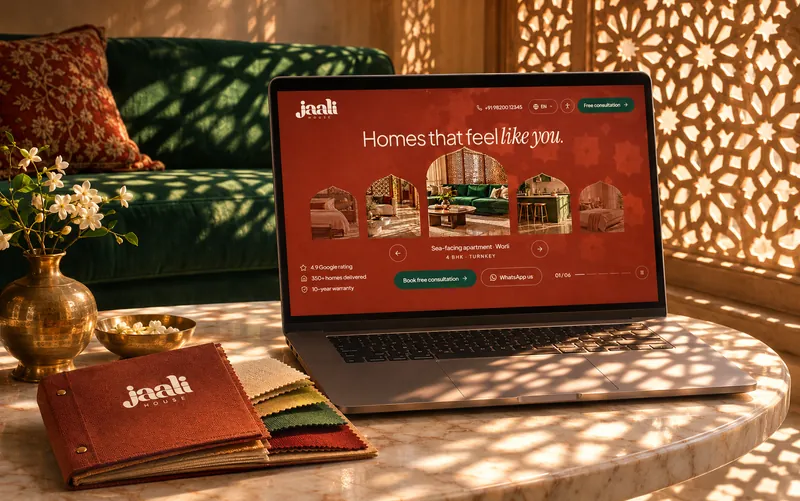 See the project · BrandsJaali HouseInterior design studio · lead generationLead generation done with taste. Every section has a Consult or WhatsApp button, sticky bars follow on desktop and mobile, and a one-time pop-up appears after four secon…
Search terms worth owning
- #interior designer
- #luxury interior design
- #home interior design
- #turnkey interiors
- #office interior design
- #architecture firm
Questions people ask
What should an interior designer's website include?
Full project stories, a clear process, a price signal, a short brief or quiz form, and Consult and WhatsApp buttons in every section. Add the founder's point of view and real before-and-after photos.
Should interior designers show prices on their website?
Show budget bands or a starting figure rather than nothing. It saves both sides time: the homeowner knows whether to enquire, and the studio stops spending calls on projects that don't fit.
How can an interior studio get better leads from Instagram ads?
Send ad traffic to a focused landing page, not the home page. Ask three or four qualifying questions, capture the campaign tag with each answer, and offer WhatsApp as the next step. Jaali House works this way.
Do architects need to show their Council of Architecture registration?
It is a strong trust signal and worth showing. Under the Architects Act, 1972, only people registered with the Council of Architecture can use the title “architect” in India.
How do interior design websites rank locally?
Name project pages by place and type, such as “3 BHK interior, Bandra”, build a page for each city you work in, and keep your Google Business Profile current with real project photos.
How do I keep a portfolio website fast?
Serve images as WebP or AVIF in responsive sizes, lazy-load everything below the first screen, and load Instagram embeds only when someone clicks them.
Five questions that qualify a brief
Five questions are enough to tell a serious project from a browse. Ask them in this order, one per screen.
Property type and size
Scope: full home, kitchen, single room or office
City and possession date
Budget band
Style references or a Pinterest board
Technical SEO for architecture & interiors
Design studios are judged on images, and images are what slow sites down and hide them from search.
- Project URLs named by place and type
- Descriptive alt text that names materials and spaces
- ProfessionalService or HomeAndConstructionBusiness schema with areaServed
- A location page for each city you work in
- Responsive AVIF or WebP images, lazy-loaded
- Instagram and video embeds loaded on click to protect LCP and INP
Updated 7 Nov 2026 · Aliasgar Barodawala